





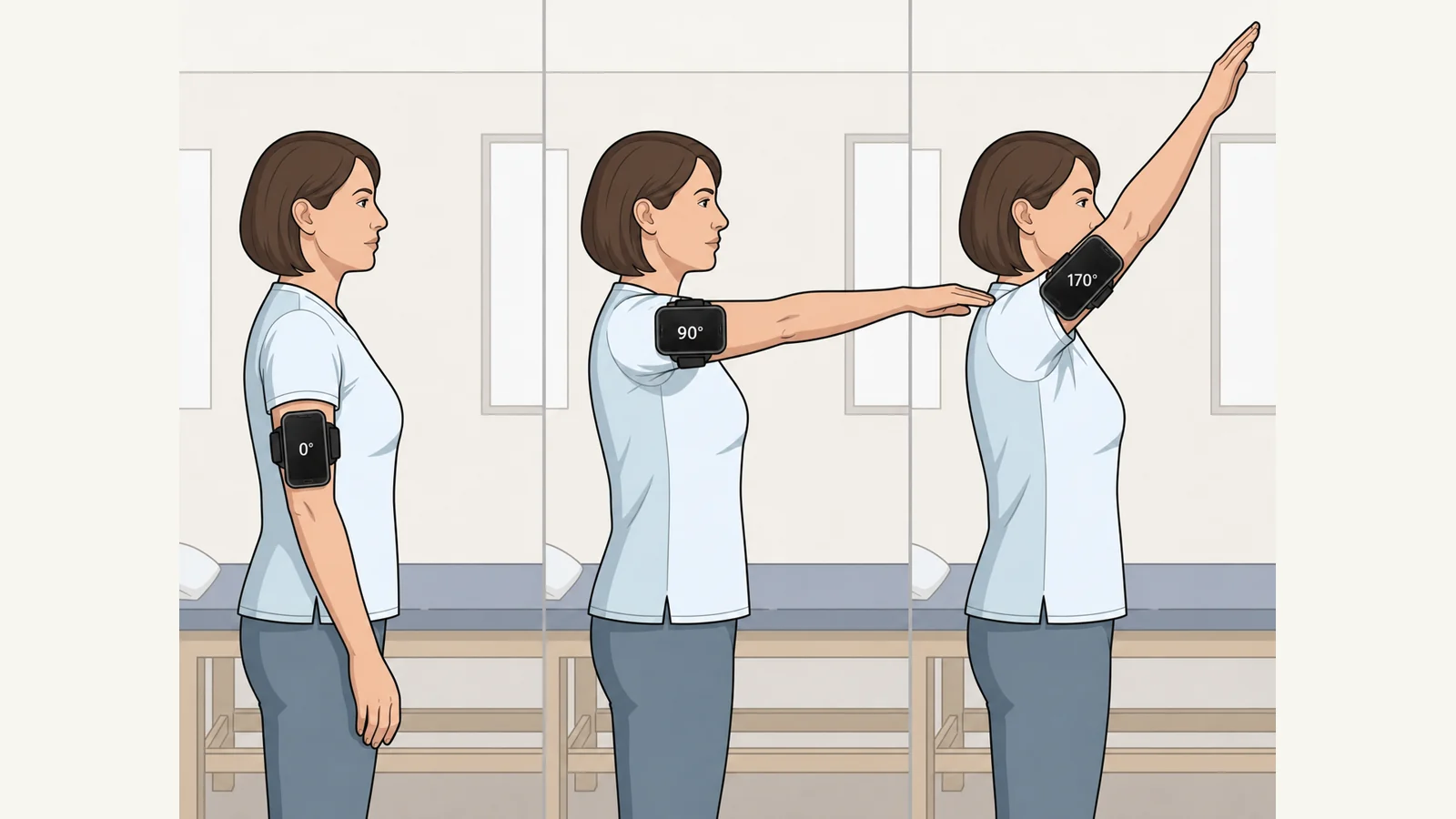
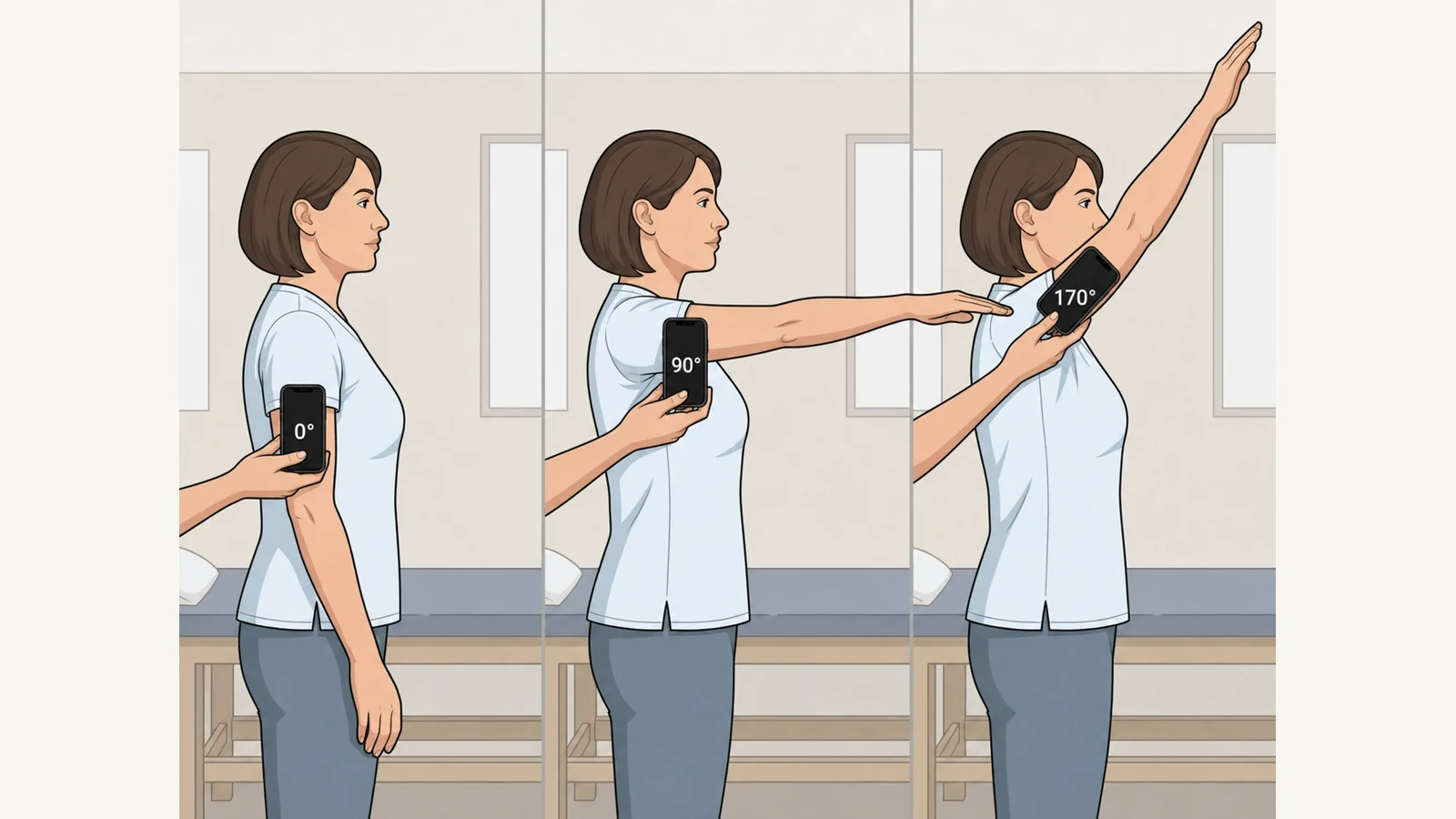
Measurement Snapshot
There is no single value that establishes normality for every person or method. Record the setup and compare measurements in clinical context.
Compare active and passive shoulder flexion to separate strength or motor-control limits from capsular restriction. Use repeated measurements to track change, not to diagnose pathology in isolation.
Standardized Setup
- Patient Position
- Seat or stand the patient tall with a neutral lumbar spine, or place the patient supine on a firm table when trunk control is difficult.
- Stabilization
- Stabilize the trunk and scapula so the patient does not arch the back, shrug, or rotate the torso to gain extra range.
- Landmarks
- Align the axis near the lateral humeral head, the stationary reference with the lateral trunk, and the moving reference with the lateral humerus toward the lateral epicondyle.
Step-by-Step Measurement
- Calibrate the starting position with the arm at the side and the elbow extended.
- Ask the patient to raise the arm forward through a comfortable active range.
- Stop at the first clear compensation, pain-limited end range, or true maximum elevation.
- Record active ROM first, then document passive ROM separately if the clinical workflow requires it.
Common Measurement Errors
- Lumbar extension that makes the shoulder angle look larger than it is.
- Scapular elevation before the glenohumeral end range is reached.
- Phone placement drifting away from the lateral upper arm during the lift.
Guided Cobb Angle Pro Workflow
This movement has a named protocol in the app. Choose the measured side and one of its supported positions before capture.
- In Range of Motion, choose Shoulder, then the guided Shoulder Flexion protocol and the measured side and position.
- For Phone Sensor, secure the phone to the upper arm with its top pointing toward the shoulder. The app also offers Photo and Camera capture.
- Set neutral with the arm by the side, raise it forward while keeping the trunk upright, capture the end-range value, and record the setup in the notes.
References
- Norkin CC, White DJ. Measurement of Joint Motion: A Guide to Goniometry. 5th ed. F.A. Davis Company; 2016.
- American Academy of Orthopaedic Surgeons. Joint Motion: Method of Measuring and Recording. Chicago: AAOS; 1965.
Frequently Asked Questions
How should shoulder flexion measurements be interpreted?
Record the measured value with the side, patient position, method, and active or passive status. Compare repeat measurements made the same way and interpret them with the full clinical context; one value alone cannot establish normality or a diagnosis.
How do you measure shoulder flexion with a phone inclinometer?
Zero the device with the arm at the side and the elbow extended, secure the phone to the lateral upper arm or hold it in the movement plane, raise the arm forward through a comfortable range, and capture the value at the first clear compensation or true end range.
Why does shoulder flexion look larger than it should?
Lumbar extension and scapular elevation are the most common reasons a measurement is inflated. Stabilize the trunk and scapula so the reading reflects glenohumeral motion rather than compensation.