





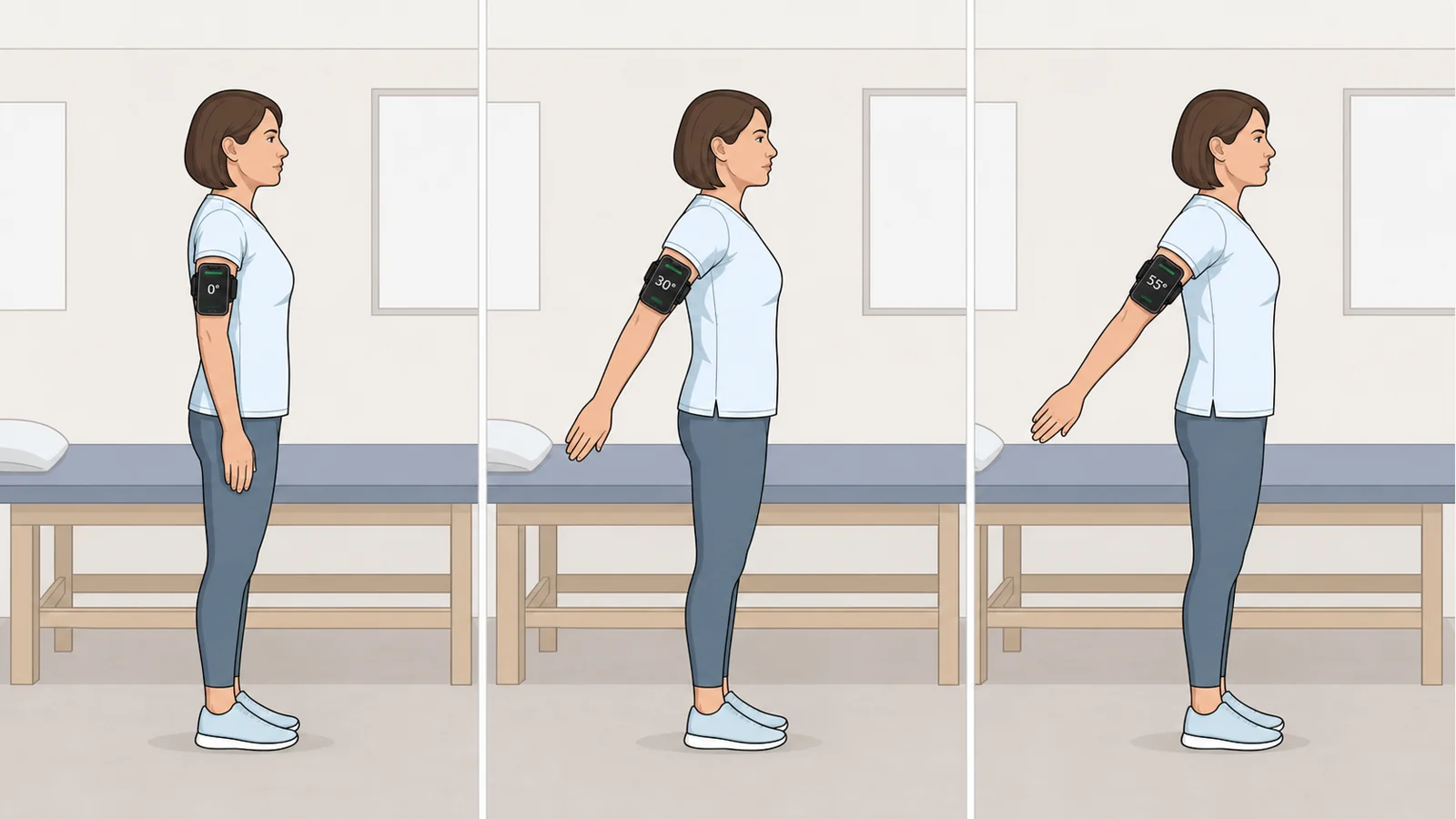
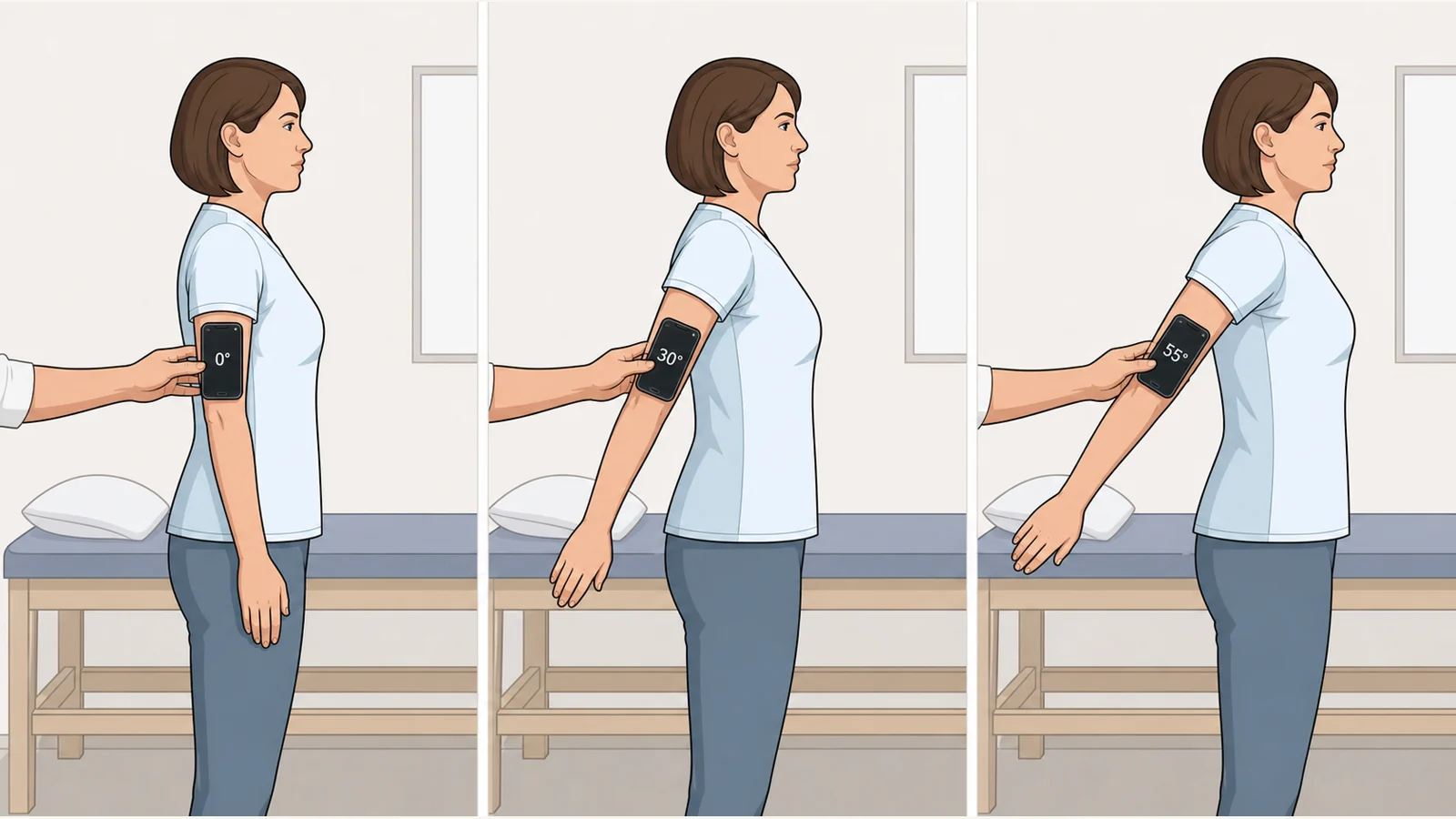
Measurement Snapshot
There is no single value that establishes normality for every person or method. Record the setup and compare measurements in clinical context.
Shoulder extension measures posterior arm travel and is useful for tracking mobility after trauma, impingement-related stiffness, and capsular restriction workflows.
Standardized Setup
- Patient Position
- Use prone lying when available, or standing with a neutral trunk when table positioning is not practical.
- Stabilization
- Stabilize the scapula and shoulder girdle to prevent trunk rotation, forward lean, or anterior tilting of the shoulder.
- Landmarks
- Use the lateral acromion region as the axis, the lateral trunk as the stationary reference, and the lateral humerus toward the lateral epicondyle as the moving reference.
Step-by-Step Measurement
- Begin with the arm at the side and the elbow fully extended.
- Calibrate the device at the neutral vertical start position.
- Move the arm posteriorly without allowing trunk lean or elbow flexion.
- Record the end-range value and note whether the movement was active or passive.
Common Measurement Errors
- Leaning the trunk forward to create the appearance of more shoulder extension.
- Letting the elbow bend during the posterior lift.
- Failing to stabilize the scapula when anterior shoulder tilt begins.
Custom Cobb Angle Pro Workflow
The app does not provide a named protocol for this movement. Use Custom as the body part, choose the movement, and apply your own clinical measurement method.
- In Range of Motion, choose Custom as the body part, then Extension as the movement. The app does not provide a named Shoulder Extension protocol.
- Choose Photo, Camera, or Phone Sensor and use your own measurement setup. Custom measurements have generic in-app guidance rather than a reviewed movement-specific protocol.
- Record Shoulder Extension, side, position, and method in the case label or notes so the saved Custom measurement can be interpreted later.
References
- Reese NB, Bandy WD. Joint Range of Motion and Muscle Length Testing. 3rd ed. Saunders; 2016.
- American Academy of Orthopaedic Surgeons. Joint Motion: Method of Measuring and Recording. Chicago: AAOS; 1965.
Frequently Asked Questions
How should shoulder extension measurements be interpreted?
Record the measured value with the side, patient position, method, and active or passive status. Compare repeat measurements made the same way and interpret them with the full clinical context; one value alone cannot establish normality or a diagnosis.
What position is best for measuring shoulder extension?
Prone lying is preferred when a table is available because it limits trunk lean. Standing with a stabilized, neutral trunk is an acceptable alternative when prone positioning is not practical.
What compensations inflate a shoulder extension measurement?
Forward trunk lean, elbow flexion during the lift, and anterior tilting of the shoulder all add apparent extension. Stabilize the scapula and shoulder girdle to keep the reading valid.