





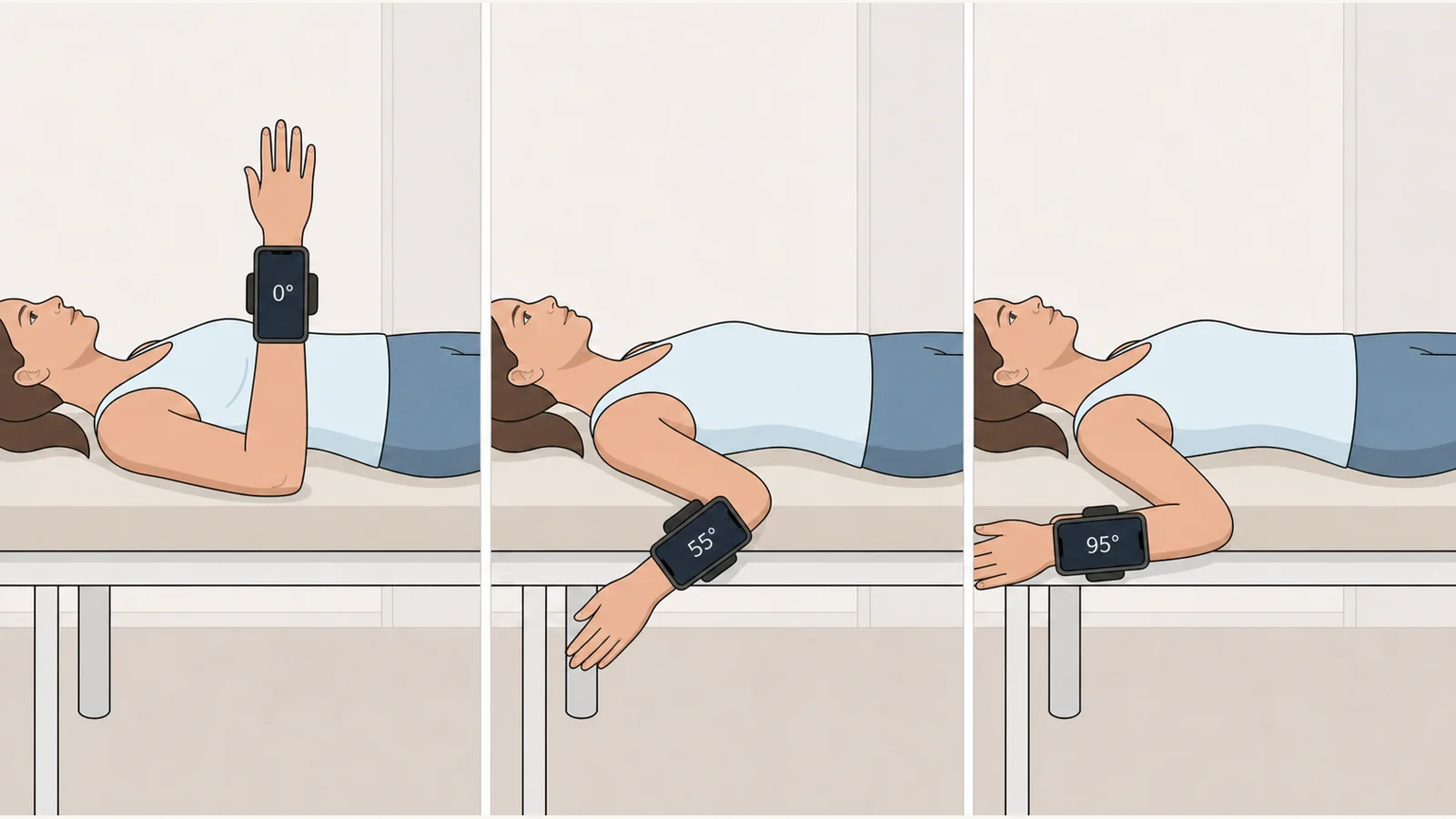
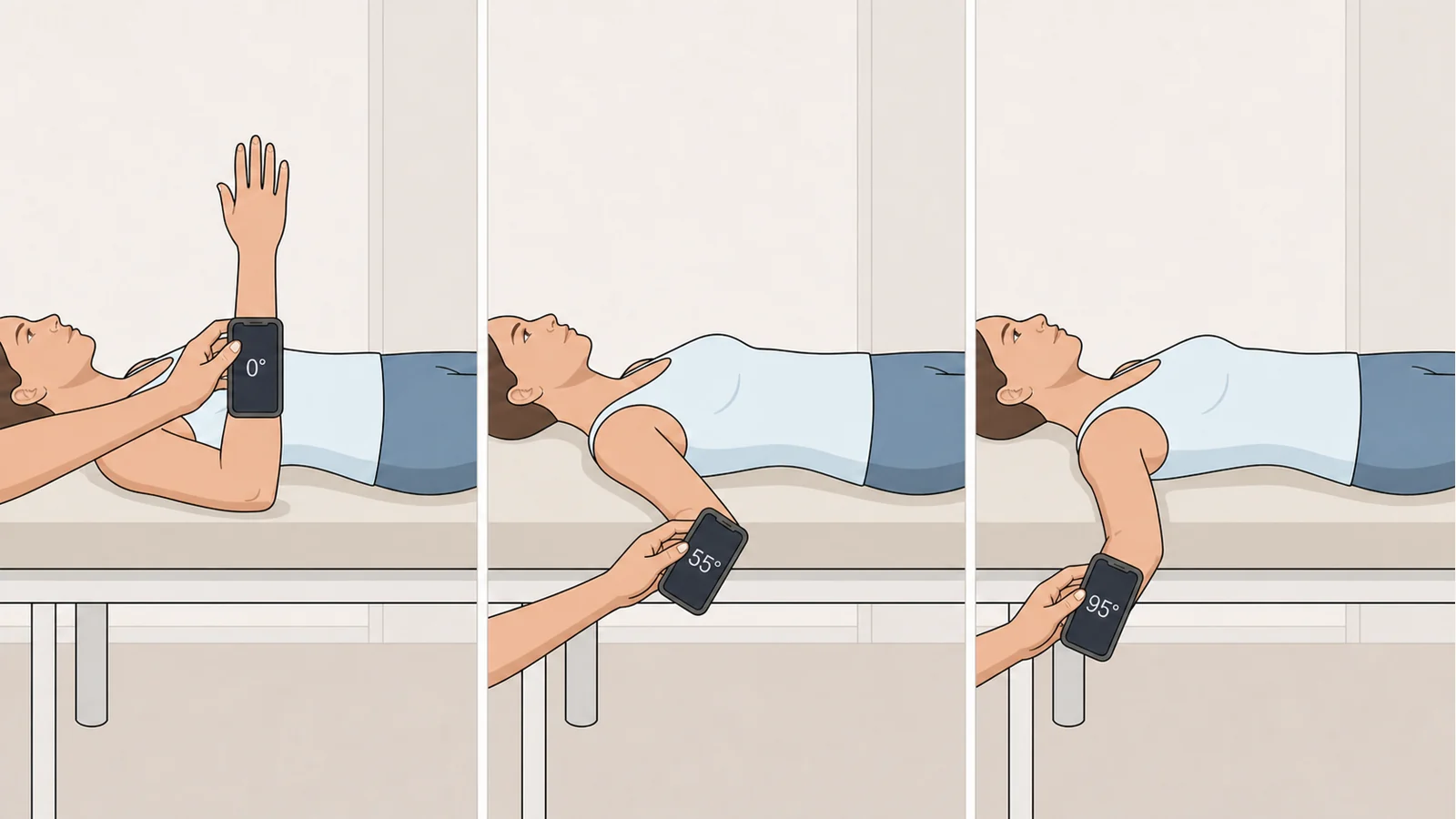
Measurement Snapshot
There is no single value that establishes normality for every person or method. Record the setup and compare measurements in clinical context.
External rotation helps document rotator cuff and shoulder mobility workflows, especially when paired with internal rotation and total rotational arc.
Standardized Setup
- Patient Position
- Place the patient supine with shoulder abduction at 90 degrees, elbow flexion at 90 degrees, and the forearm vertical before rotation begins.
- Stabilization
- Stabilize the distal humerus and trunk to prevent spinal extension, elbow drift, or shoulder translation at end range.
- Landmarks
- Use the olecranon as the axis, vertical as the stationary reference, and the ulna toward the ulnar styloid as the moving reference.
Step-by-Step Measurement
- Calibrate the vertical forearm start position as zero.
- Rotate the forearm backward toward the table while maintaining shoulder and elbow position.
- Stop before spinal arching, shoulder translation, or elbow extension changes the test.
- Record active and passive values separately when both are measured.
Common Measurement Errors
- Arching the thoracic or lumbar spine at end range.
- Letting the elbow open beyond 90 degrees.
- Failing to keep the shoulder abducted at the same angle throughout the test.
Custom Cobb Angle Pro Workflow
The app does not provide a named protocol for this movement. Use Custom as the body part, choose the movement, and apply your own clinical measurement method.
- In Range of Motion, choose Custom as the body part, then External Rotation as the movement. The app does not provide a named Shoulder External Rotation protocol.
- Choose Photo, Camera, or Phone Sensor and use your own measurement setup. Custom measurements have generic in-app guidance rather than a reviewed movement-specific protocol.
- Record Shoulder External Rotation, side, position, and method in the case label or notes so the saved Custom measurement can be interpreted later.
References
- Ellenbecker TS, Roetert EP, Bailie DS, et al. Glenohumeral joint internal and external rotation range of motion in elite tennis players. J Athletic Training. 1996;31(4):305-310.
- Norkin CC, White DJ. Measurement of Joint Motion: A Guide to Goniometry. 5th ed. F.A. Davis Company; 2016.
Frequently Asked Questions
How should shoulder external rotation measurements be interpreted?
Record the measured value with the side, patient position, method, and active or passive status. Compare repeat measurements made the same way and interpret them with the full clinical context; one value alone cannot establish normality or a diagnosis.
How do you keep the trunk from adding to external rotation?
Stabilize the distal humerus and trunk and stop before spinal arching, shoulder translation, or elbow extension changes the test, so the value reflects true glenohumeral rotation.
Should external and internal rotation be measured together?
Yes. Pairing external and internal rotation to compute the total rotational arc gives more clinical context than either value in isolation, especially in overhead-athlete workflows.