





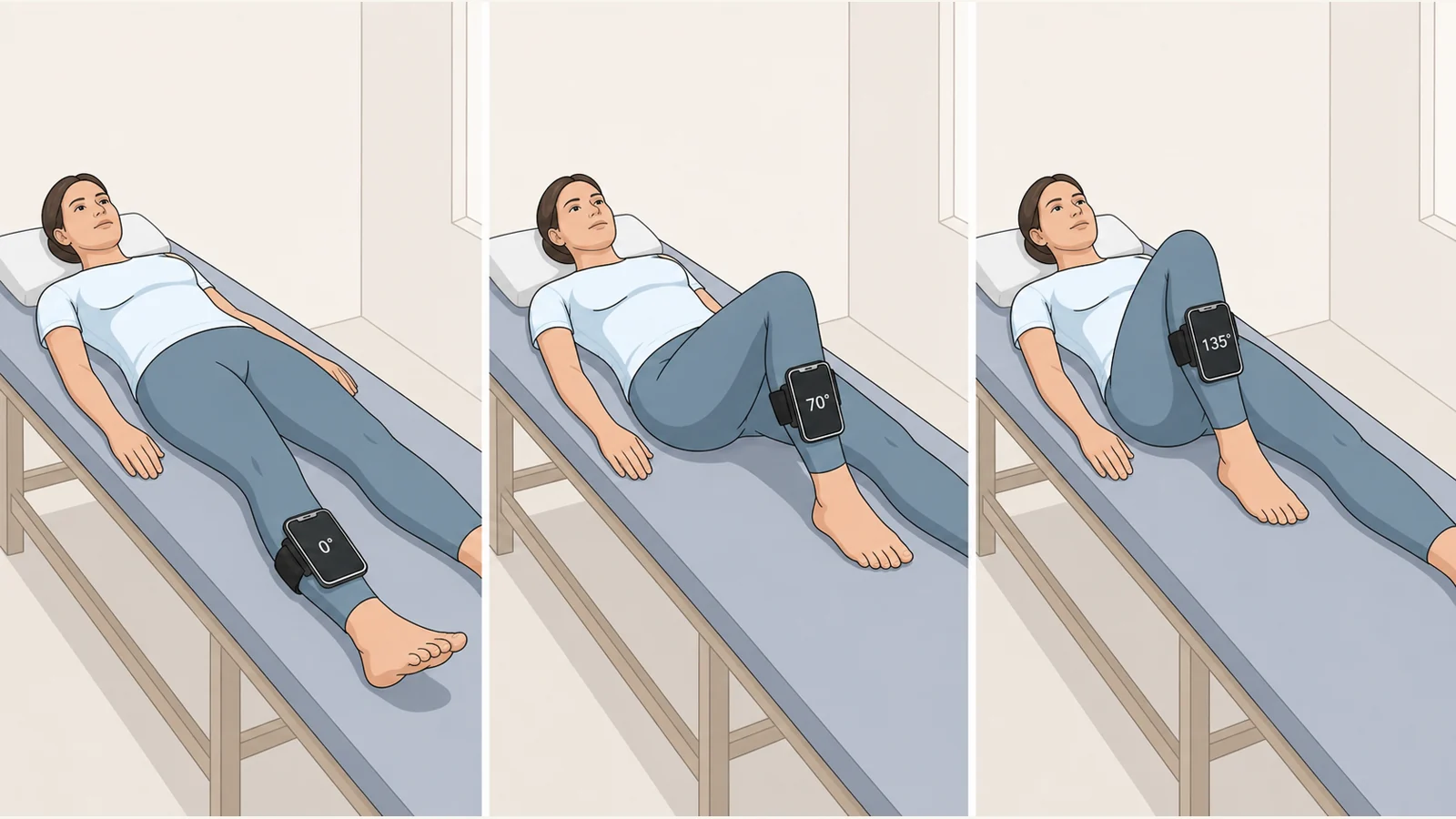
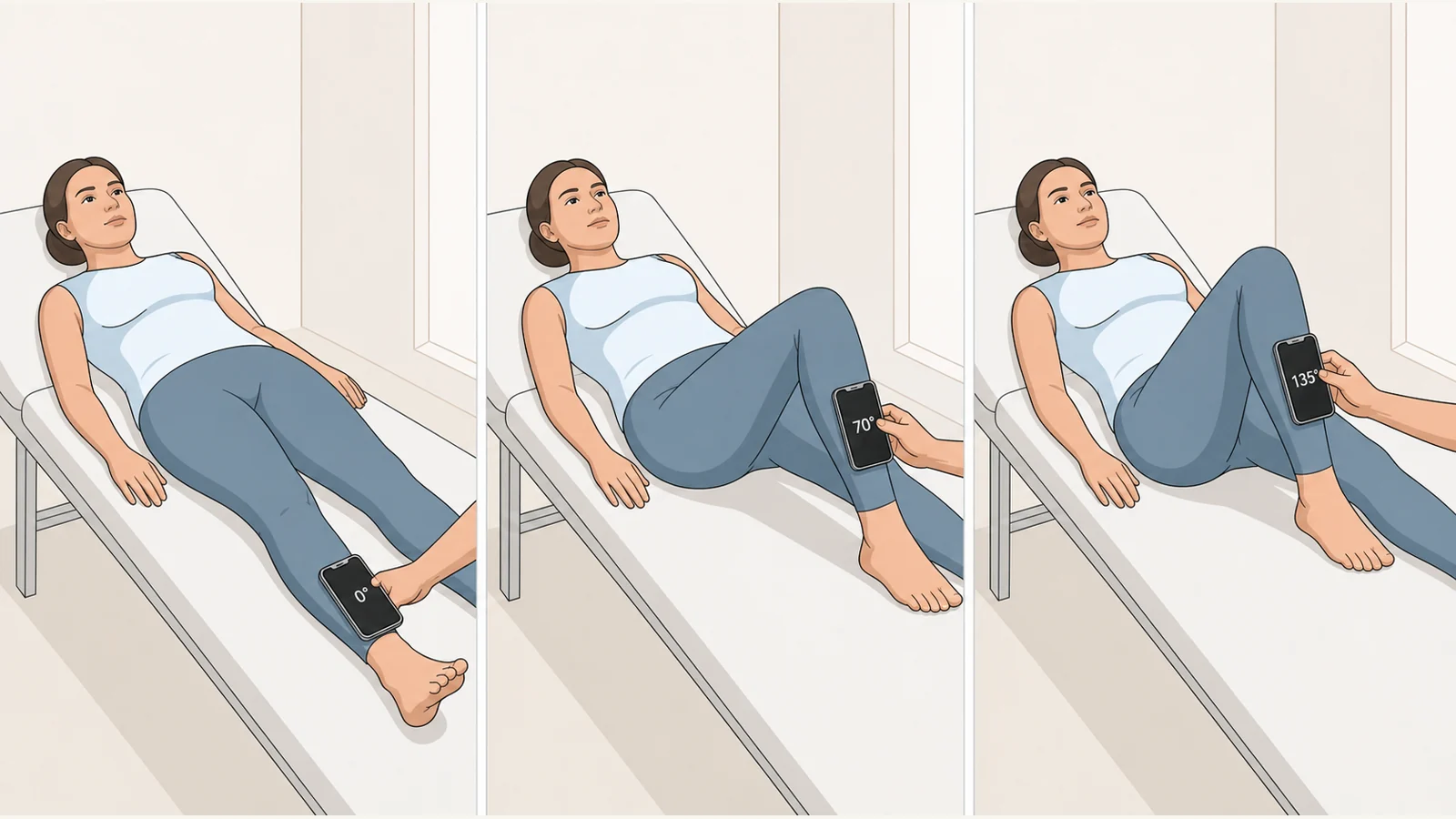
Measurement Snapshot
There is no single value that establishes normality for every person or method. Record the setup and compare measurements in clinical context.
Knee flexion ROM is commonly followed after ACL reconstruction, meniscus repair, total knee arthroplasty, and mobility-focused rehabilitation. Interpret change alongside swelling, pain, strength, and surgical precautions.
Standardized Setup
- Patient Position
- Place the patient supine and allow the hip to flex enough that knee bending is not blocked by thigh-abdomen contact too early.
- Stabilization
- Stabilize the femur and pelvis to prevent hip rotation, pelvic lift, or lower-limb abduction during the test.
- Landmarks
- Use the lateral femoral epicondyle as the axis, the greater trochanter as the proximal reference, and the lateral malleolus as the distal reference.
Step-by-Step Measurement
- Calibrate full knee extension as the starting angle when clinically appropriate.
- Flex the knee through the available sagittal-plane range.
- Keep the shin aligned and prevent the hip from rolling outward.
- Record the maximum angle and document supine, prone, active, or passive status.
Common Measurement Errors
- Allowing hip rotation to add apparent knee flexion.
- Changing the pelvis position between repeated measurements.
- Comparing active and passive values without labeling them separately.
Guided Cobb Angle Pro Workflow
This movement has a named protocol in the app. Choose the measured side and one of its supported positions before capture.
- In Range of Motion, choose Knee, then the guided Knee Flexion protocol. Select the measured side and a supported supine or prone position.
- For Phone Sensor, secure the phone to the lower leg with its top pointing toward the knee. Photo and Camera capture are also available.
- Set neutral in the reviewed start position, bend the knee while keeping the thigh supported, capture the end range, and save the position and method in the notes.
References
- Petersson LE, Nilsson H. Reliability of knee joint range of motion measurements. Physiotherapy Res Int. 2002;7(2):87-95.
- Norkin CC, White DJ. Measurement of Joint Motion: A Guide to Goniometry. 5th ed. F.A. Davis Company; 2016.
Frequently Asked Questions
How should knee flexion measurements be interpreted?
Record the measured value with the side, patient position, method, and active or passive status. Compare repeat measurements made the same way and interpret them with the full clinical context; one value alone cannot establish normality or a diagnosis.
How is knee flexion tracked after surgery?
Knee flexion is commonly followed after ACL reconstruction, meniscus repair, and total knee arthroplasty. Use the same patient position each visit and label active versus passive so serial values are comparable.
What causes an inaccurate knee flexion measurement?
Hip rotation, an inconsistent pelvis position between visits, and mixing active and passive values without labeling them are the most common sources of error.